Prepping Your Idaho Soil: 3 Mistakes to Avoid When Growing Peonies in Idaho
By Melissa Warner, Portneuf Valley Peonies — Pocatello, Idaho | May 2026
Here is something most gardening guides will not tell you: a peony planted correctly today can still be blooming in your grandchildren’s garden. These are 50-year plants. That changes how you think about May.
May is not just another month in the garden calendar. For anyone growing peonies in Idaho, it is the most consequential window of the year. The decisions you make now about soil chemistry, irrigation depth, and understanding your plant’s biology will compound across every single season that follows. Get the foundation right, and you are not just planting a flower. You are making a five-decade investment.
As former chemical engineers who now run a boutique peony farm in Pocatello, we approach those decisions analytically. Here are the three mistakes we see most often, and exactly how to avoid them.
Table of Contents 1. Mistake 1: Ignoring Idaho’s Alkaline Soil 2. Mistake 2: Shallow Watering in a High-Desert Climate 3. Mistake 3: The Ant Myth — What Ants Actually Do for Your Peonies 4. The Engineering Advantage: Building a 50-Year Garden 5. Resources & Next Steps |
Mistake 1: Ignoring Idaho’s Alkaline Soil |
The Alkalinity Issue: Why Idaho Soil Works Against You (And How to Fix It)
Southeast Idaho’s volcanic geology is beautiful to look at and brutal on your garden chemistry. Most Portneuf Valley soil tests at a pH above 7.5 well into the alkaline range. For growing peonies in Idaho, this is the single most important variable to understand, because peonies are particular about pH.
Peonies prefer a slightly acidic to neutral environment: pH 6.5 to 7.0. Once you climb past 7.5, the chemistry starts working against you. Iron and manganese become chemically “locked” in the soil — present in the ground, but unavailable to the plant. The result is chlorosis: yellowing leaves, reduced vigor, stems that lack the strength to hold up Idaho’s afternoon winds, and blooms that underperform year after year.
How We Manage It at Portneuf Valley Peonies: Step 1: We soil-test every planting bed each spring through the University of Idaho Extension Service. Step 2: We apply elemental sulfur in calculated amounts based on the test result — not guesswork. Step 3: We incorporate well-aged compost to build organic matter, which buffers pH naturally over time. Step 4: We retest 60 days after amendment and adjust. This is the same iterative approach we used in process engineering — measure, adjust, verify. |
Growing peonies in Idaho is absolutely achievable on alkaline soil. But it requires that first step: know what you are working with before you plant. A soil test costs less than a coffee and protects a 50-year investment.
“Alkaline soil is not a death sentence for your peonies. It is a variable — and variables are meant to be engineered around.”
Mistake 2: Shallow Watering in a High-Desert Climate |
Water-Wise Irrigation: The Deep Soak Method vs. Shallow Sprinkling
May in Southeast Idaho can be deceptively dry. We average around 12 inches of annual precipitation in Pocatello, less than half the national average, and spring moisture is inconsistent at best. The instinct for many gardeners is to compensate by watering frequently. In a high-desert climate, frequent light watering is one of the most damaging things you can do to a peony.
Why Shallow Watering Backfires
When water only penetrates the top two or three inches of soil, peony roots follow it — growing upward toward the moisture rather than downward into the cool, stable earth. Shallow-rooted plants are then the most vulnerable to our Idaho extremes: they burn in July, struggle in drought, and are susceptible to root rot when rains do arrive heavily.
The Deep Soak Method
The correct approach is the opposite of frequent sprinkling: water less often, but deeply.
The Deep Soak Protocol We Use on the Farm: Water once or twice per week — never daily. Each watering should penetrate 8 to 12 inches into the soil. Use a slow drip or soaker hose at the base of the plant, not overhead sprinklers. Let the surface dry out between sessions. The goal is to train roots downward into the cooler, more stable Idaho earth — where they will anchor the plant through heat, wind, and drought. |
Overhead sprinklers add an additional risk: wet foliage in our variable May temperatures is an invitation for botrytis blight, a fungal disease that can devastate an emerging peony season quickly. Drip irrigation at the root zone eliminates this risk entirely.
“Deep, infrequent watering is one of the highest-impact changes a home gardener can make. The difference in stem counts and bloom size between a deeply-rooted plant and a shallow one is dramatic.”
Mistake 3: The Ant Myth — Misunderstanding What Ants Actually Do |
The Idaho Ant Question: Do You Need Ants for Peonies to Bloom?
This is one of the most common questions we hear at the Portneuf Valley Farmers Market: “Do I need ants for my peonies to bloom?” It is a completely understandable question — anyone who has watched Idaho ants swarm over a peony bud naturally wonders if something essential is happening. The short answer is no. But the real answer is more interesting.
Myth vs. Reality MYTH: Ants are required for peony buds to open. Without them, the blooms will stay closed. REALITY: Ants are not required for blooming. Peonies open perfectly well without them — as any florist who grows them in a controlled environment will confirm. The relationship is entirely driven by the peony, not the ant. |
The Real Science: A Mutually Beneficial Relationship
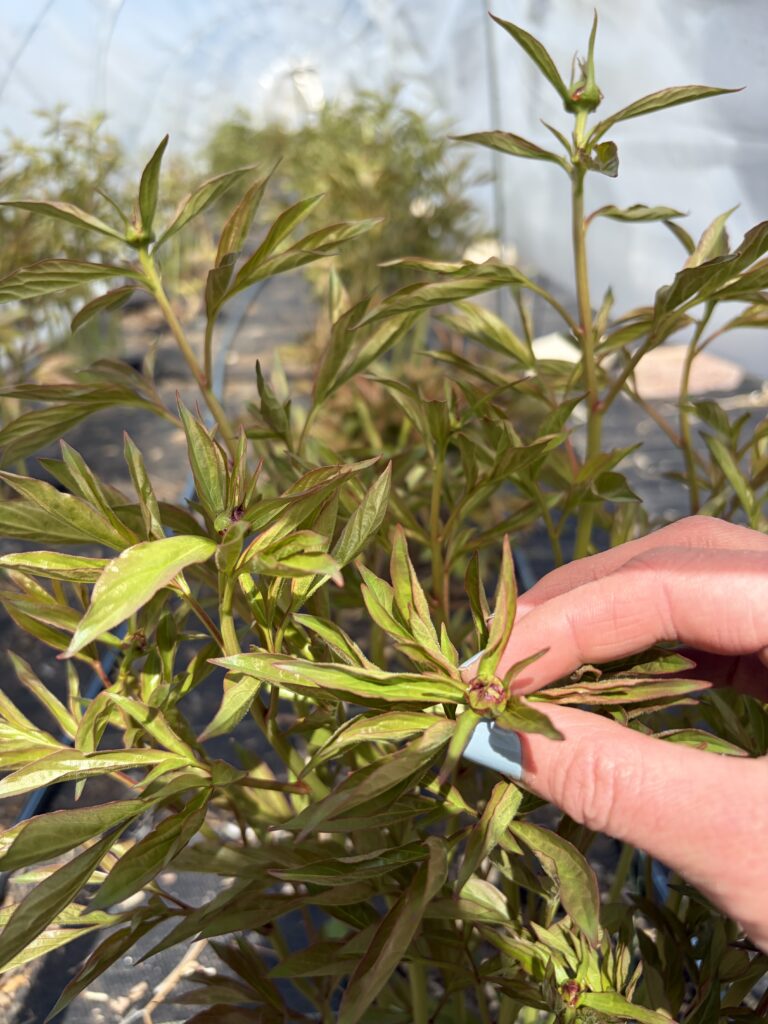
Peony buds produce a sugary nectar on their outer surface before they open. This nectar is an attractant — a resource the plant offers in exchange for a service. Ants consume the nectar and, in return, actively defend the bud from other insects that might damage it. Some studies suggest ants may also help remove a waxy coating on the bud that can slow opening, though this is a secondary effect at most.
The relationship is mutualistic but not obligate. The peony benefits from having a defensive guard, and the ants benefit from a reliable food source. But the plant is not dependent on the ant to bloom. When you bring cut peony stems inside — ants and all — give them a gentle shake or rinse the buds under cool water. They will open beautifully within one to two days in a warm room.
Practical Note for Cut Flower Enthusiasts: When harvesting stems at the ‘marshmallow stage’ — bud fully coloured but not yet open — take them inside and place them in fresh water at room temperature. Ants do not need to be present. The bloom will open on its own timeline. If you want to slow the process, place stems in the refrigerator. This is exactly how we condition stems at Portneuf Valley Peonies before market day. |
So the next time you see Idaho ants on your peony buds, you can appreciate the scene for what it is: a fascinating piece of plant ecology happening right in your garden. But don’t worry about growing peonies in Idaho without them. Your blooms are in no danger.
The Engineering Advantage: Building a 50-Year Garden
Most perennial gardening advice is written for temperate climates with forgiving soils and predictable rainfall. Southeast Idaho is none of those things. Our volcanic alkaline soil, semi-arid rainfall, high-altitude UV, and wide temperature swings require a more deliberate approach.
That is what our engineering background gives us: the habit of measuring before acting, iterating based on data, and not assuming that what works elsewhere will work here. Growing peonies in Idaho successfully is not complicated — but it does require understanding your specific environment and respecting what a peony actually needs.
Get the soil chemistry right in May. Water deeply from the start. Understand your plants’ biology rather than relying on gardening folklore. Do those three things, and you will have blooms that improve every single year for the next half-century.
“Peonies are not a flower you manage. They are a relationship you build — and in Idaho, the soil and climate make every bloom you earn feel genuinely worth it.”
Resources & Next Steps
On Our Site: Peony Varieties & Care — Planting guide, variety profiles & stem care
On Our Site: 2026 Idaho Bloom Forecast — When to expect peak season by variety
On Our Site: Events & Market Schedule — Full 2026 Farmers Market calendar
External: USDA Plant Hardiness Zone Map — Find your exact Idaho zone
External: University of Idaho Extension — Soil Testing Center
Want a Head Start This Season? Shop our ‘Root-Ready’ peony varieties — cold-hardy selections hand-chosen for Southeast Idaho’s alkaline soil and high-desert climate. Pre-orders are open now for the 2026 season. Pre-order your Root-Ready varieties: portneufvalleypeonies.com/shop-peonies Portneuf Valley Farmers Market · Idaho Falls Farmers Market — All of June pvpeonies@gmail.com · (208) 292-9143 |