From Engineers to Flower Farmers: The Story Behind Portneuf Valley Peonies
By Melissa Warner, Portneuf Valley Peonies — Pocatello, Idaho
People often laugh a little when we tell them what we used to do for a living. Chemical engineers. The kind of people who spend their days thinking in process flows, mass balances, and reaction kinetics. The kind of people who, professionally speaking, are about as far from a flower farm as it is possible to be.
And yet here we are, every June, standing at the end of a row of blooming peonies in Pocatello, Idaho, trying to keep up with the harvest.
This is the story of how that happened. How two engineers found 3.5 acres and a dream, planted 540 roots into an Idaho pasture with more hope than experience, and built something that has surprised us at every turn. It is a story about land and patience and the particular joy of growing something beautiful from the ground up — which, it turns out, is not so different from engineering after all.
Two Engineers, One University, a Lot of Chemistry
Theo and I met at the University of Idaho, both studying chemical engineering. We were the kind of students who liked hard problems — the satisfaction of working through something complex and arriving at an answer that actually held up under scrutiny. Engineering trains you to think that way. You learn to respect systems: inputs, processes, outputs. You learn that details matter. You learn that patience and precision, applied consistently, produce results.
We did not know then how useful all of that would turn out to be when we eventually decided to grow flowers.
After graduating, our careers brought us to Pocatello in 2010. We settled into a quiet subdivision, started building a life, and expected — as people do — that we had found the shape our future would take. For a while, we had.
Engineering trains you to think in systems. It took us a decade to realise that a flower farm is just another kind of system — one that runs on soil, water, sunlight, and time.
2020: Three and a Half Acres and a Different Kind of Life
For all the things we appreciated about neighborhood living, something had been quietly missing. We had both grown up with land — the sense of space that comes from wide skies and room to walk without hitting a fence. Subdivision life was comfortable, but it had edges. You could feel them.
In 2020, we found our property. Three and a half acres on the outskirts of Pocatello, with pasture grass and a view that felt like exhaling after holding your breath for a long time. There were no immediate plans beyond the simple fact of it: space. Room to breathe. Trees and soil and the particular quiet of a place that has not been managed to within an inch of its life.
We bought it and moved without fully knowing what we were going to do with it. We just knew it was right.
The Idea That Started Everything (It Was My Sister’s)
The flower farm idea arrived the following autumn, in the way that the best ideas often do: from someone else entirely.
My sister Crystal mentioned it almost in passing. She had been reading about peony farming and thought the image of it — rows of romantic blooms stretching across an Idaho pasture, tended by hand, harvested into buckets of cool water on June mornings — was exactly the kind of thing our land was suited for.
I cannot fully explain why it landed the way it did. I had always loved flowers, but I had never thought of myself as a grower. The engineering brain in me, though, started turning it over almost immediately. Peonies are perennials — you plant once and harvest for decades. They have a defined season, predictable growth patterns, and a well-documented body of horticultural knowledge. They are, in other words, a system you can study and understand.
By the time I had finished reading everything I could find about them, I was already thinking about row spacing.
Crystal mentioned peonies, and within a week I had ordered books, pulled soil samples, and started mapping out the pasture. Theo had drawn up an irrigation schematic. That’s just how we’re wired.
540 Roots, One Pasture, and Equal Parts Hope and Uncertainty
Our first order was 540 peony roots. We chose varieties we had researched carefully — classic herbaceous types with proven cut flower performance, strong vase life, and a range of colours from deep red through blush to white. We mapped out our rows on graph paper first, accounting for spacing, airflow, irrigation lines, and harvest access. We did soil amendments. We planned the drainage.
Then we got outside with our hands in the dirt and learned everything the books had not told us.
There is a gap, it turns out, between understanding a system theoretically and actually running one. Soil behaves differently than the data suggests. Roots establish at their own pace, not yours. The weather does not care about your timeline. Our first season humbled us in the best possible way — the way that any honest encounter with growing things tends to do.
Peonies do not bloom prolifically in their first year. Or always in their second. They are building roots — establishing the underground infrastructure that will eventually power decades of flowering. For two people trained to optimise for measurable outputs, learning to sit with that lag required a genuine adjustment in how we defined progress.
We learned it. And in year three, when the rows finally came in full, we understood what patience in agriculture actually means. It is not passive waiting. It is consistent work done in faith that the system is functioning correctly underground, where you cannot see it yet.
How the Farm Works Today
Portneuf Valley Peonies now grows just over 1,000 roots across 15 varieties on our 3.5-acre property in Pocatello. The season runs from late May through early July, with peak bloom — and peak chaos, in the best sense — all of June.
Theo and I have divided the work along lines that match our strengths, though in practice those lines blur considerably.
Theo: Field & Operations
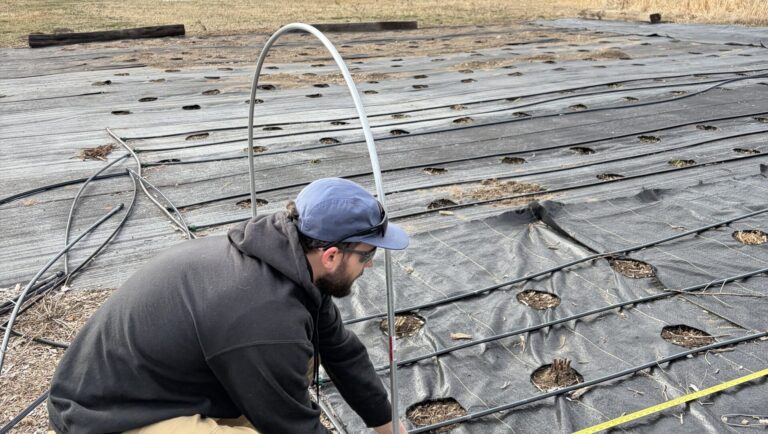
Theo manages the physical farm — planting, irrigation design and maintenance, soil health, structural work, and all of the systems that keep a productive growing operation functioning. If chemical engineering gave us one truly transferable skill for farming, it is this: the ability to design and troubleshoot a system under constraint. Theo applies that every day, from adjusting drip line pressure to figuring out why one row underperforms relative to its neighbors.
Melissa: Growing, Harvest & Market
I manage the growing calendar, variety selection, harvest timing, cut flower conditioning, and everything that faces the customer — the farmers market tables, the pre-orders, the blog, the communication. The part of engineering I always liked most was the interface between the technical system and the people it served. At the market, that interface is a bucket of fresh peonies and a conversation about which variety someone’s grandmother used to grow.
We are a two-person operation. There is no staff, no warehouse, no intermediary. Every stem that leaves this farm has been touched by one of us at every stage of its growth.
A Farm Built Year by Year
| 2010 | Theo and Melissa arrive in Pocatello after graduating from University of Idaho with chemical engineering degrees. Begin careers in engineering. |
| 2020 | Purchase a 3.5-acre property outside Pocatello. The pasture, the sky, and the sense of space feel immediately right. |
| 2021 | Melissa’s sister Crystal suggests growing peonies. Within weeks, the first 540 roots are ordered. Soil amended, rows mapped, irrigation designed. First planting goes into the ground. |
| 2022 | First stems emerge. Limited first-year blooms, as expected. The root systems are establishing underground. We learn patience. |
| 2023 | Year three — the farm comes into its own. First meaningful harvest. First farmers market appearances. Customers meet the farm. |
| 2024 | Farm expands to over 1,000 roots across 15 varieties. Pre-order programme launches. Wedding and event orders begin. |
| 2025 | Online shop opens. Nationwide shipping program launches. Blog established to share growing knowledge with the wider community. |
| 2026 | Sixth season in the ground. Peak season all of June. Finding us at the Portneuf Valley Farmers Market and Idaho Falls Farmers Market — and here, on this page. |
What Engineering Actually Taught Us About Growing Flowers
People sometimes frame our story as a departure, engineers who left their field to do something completely different. We think about it the other way.
Farming, done well, is an engineering problem. You are managing inputs (water, nutrients, sunlight, temperature), optimising a process (root development, canopy management, pest and disease prevention), and producing an output (a high-quality cut flower with maximum vase life and aesthetic value). Every decision on the farm has a chain of consequences. Every system interacts with every other system.
What we brought from engineering was not irrelevant to farming. It was, in many ways, exactly right for it:
- Comfort with complexity: A growing operation has dozens of variables interacting simultaneously. Soil pH, irrigation volume, canopy spacing, variety-specific disease susceptibility, harvest timing. Managing that complexity is genuinely similar to managing a chemical process.
- Respect for data: We keep detailed records of every variety — bloom dates, stem counts, vase life observations, year-on-year comparisons. This is what lets us make better decisions each season.
- Systematic troubleshooting: When a row underperforms, we do not guess. We work through the variables methodically — soil samples, water volume, canopy density, root depth — until we find the answer.
- Long-horizon thinking: Engineers work on projects that take years to complete. Peony farming is the same. The roots we plant today will be producing at their peak in five years. Thinking in that timescale feels natural to us.
What engineering did not prepare us for was the emotional dimension of farming. The attachment you develop to a specific plant in a specific row. The particular anxiety of watching a cold front move in when the buds are at their most vulnerable. The genuine joy of the first market morning of the season, loading the truck in the dark, arriving at the booth while the town is still waking up.
That part we had to learn from scratch. It turns out to be the best part.
Why This Work Matters to Us
We are sometimes asked whether we miss engineering. It is a fair question. We invested years in those careers. The work was interesting and the problems were real.
But what we have found in farming is something that technical work rarely offered: a direct, unambiguous connection between effort and outcome. You plant carefully, you tend consistently, you harvest at the right moment — and the result is something genuinely beautiful that goes directly into someone’s hands. A bride’s bouquet. A table center-piece at a family dinner. A bundle of stems someone buys at the market on a Saturday morning because they want their kitchen to smell like June. That directness matters. Engineering is mostly invisible — it lives in infrastructure and systems and processes that people interact with without noticing. Farming is entirely visible. It is right there: a bloom in someone’s hands that was in the ground six weeks ago.
We wanted to build something with our hands that we could stand in front of and say: we made this. The farm is that thing.
We also believe, increasingly, in the value of knowing where your flowers come from. Most cut flowers sold in the United States travel thousands of miles and pass through many hands before they reach a vase. There is nothing wrong with that, it’s how the industry works, but there is something different about a stem grown ten miles from where you are standing, by people who know your name.
Portneuf Valley Peonies is not trying to be the biggest flower farm in Idaho. We are trying to be the best small one we know how to be: attentive to the land, honest about the season, and genuinely committed to every customer who trusts us with something that matters to them.
Come Find Us
If you have made it this far, you probably understand by now that Portneuf Valley Peonies is not just a business. It is the thing Theo and I built together on three and a half acres of Idaho pasture, starting with 540 roots and a great deal of hope, and it is the thing we show up for every morning of every season.
We would love to meet you — at the Portneuf Valley Farmers Market in Pocatello, at the Idaho Falls Farmers Market, through a pre-order that arrives at your door, or simply through these pages. The farm is always here, and so are we.
Thank you for being part of this. We mean that more than we know how to say in a blog post.
— Melissa (and Theo) Warner, Portneuf Valley Peonies
Grow with us
Pre-orders for fresh-cut peonies open before each season. Join our Bloom List to be first to know.
Shop our peonies: portneufvalleypeonies.com/shop-peonies
Find us at market: Portneuf Valley Farmers Market (Pocatello) & Idaho Falls Farmers Market — all of June
Get in touch: pvpeonies@gmail.com | (208) 292-9143
More from the farm:
- Behind the Rows: Sustainable Growing Practices at Portneuf Valley Peonies in 2026 — how we farm with intention
- When Do Peonies Bloom in Idaho? — our complete Idaho peony season guide
- How to Care for Peonies After Cutting — a farmer’s step-by-step guide